
Feeding My Avatar
The Crises of Leadership and the Need for Participants

As I was writing my last piece about abolishing the presidency, I found myself getting stuck on a section about leadership. The more I wrote, the more I realized it deserved its own piece because much of the problem with centralized power is actually a problem with leadership - what it is, what we project onto it, and how it is wielded.
The abuses that come with centralized power are not limited to people with formal leadership roles. Presidents, executive directors, bosses, and elected officials obviously wield power, but so do celebrities, mentors, authors, teachers, activists, and public figures. Someone may have no official authority within an organization, but still accumulate oversized influence through wealth, attention, social capital, expertise, or charisma.
In modernity, power has a way of concentrating itself. And wherever power concentrates, there is the potential for abuse.
Lately, I have been thinking a lot about leadership because my own work has been receiving more recognition. More people are reading my books, attending my talks, and seeing me as some sort of “leader.” And it is awkward.
Part of it comes from recognizing how much it feeds my ego. Growing up, I was deeply lonely and insecure, and I felt like I had little to contribute to the world. Many teachers I have learned from speak about purpose and meaning as fundamental human needs, and for much of my life I was deeply lacking both.
So every time someone praises my work, it feeds some shadow that still lives inside me. A part of me longs for the recognition, attention, and feeling of significance. And those are all also universal needs, but when it is rooted in the pain and trauma of not having had them, the longing becomes a frozen need with an insatiable appetite. And that part of me just wants to hoard as much of it as I can gather.
In some ways, I feel like this is a relatively common human experience. Despite the reality that we live in an interdependent world, so many of us carry wounds of not belonging. And that wound feeds a constant appetite for more attention, more recognition… and more power.
I worry about my ego growing without my awareness. I worry about becoming disconnected from the hurt, lonely, and angry eight-year-old who still lives somewhere inside me. I worry about what happens when I am given influence before I have learned how to stay in relationship with the parts of myself that craves it.
Because that is often where abuses of power begin.
Feeding My Avatar
This is why I am challenging myself to make leadership be an active practice. I work with it in therapy, in community, and in relationships where people know me well enough to challenge me when necessary.
One thing I have become increasingly aware of is that when people praise me, they are not actually praising me: They are praising my avatar.
As someone with a public profile, an image of me gets projected into the world. That image is partly created through my writing, speaking, and facilitation. But it is also shaped by other people’s hopes, assumptions, projections, and desires.
The larger my platform grows, the further that avatar drifts from the actual human being that I am.
This is not because the avatar is entirely fake. My avatar is genuinely a reflection of important parts of who I am. Writing, teaching, and facilitating are among my deepest callings. They bring forward some of my best qualities.
But that is precisely the problem.
When people encounter me through my work, they are often seeing me only at my best.
They do not see the parts of me that are insecure, conflict-avoidant, selfish, impatient, lazy, or afraid. They do not see how internalized patriarchy still shows up in my relationship with my partner. They do not see how easily I become irritated with my mother or how often I fail to show up for my sisters.
They don’t see how sometimes, I just want to eat fast-food, watch a mixed martial arts fight, and spend too much money on watches I don’t need.
My avatar doesn’t have those shadows. The version of me that most people get to interact with is a disembodied, carefully crafted image of me only at my very best.
And as much as my shadow loves that image of me, it is a form of dehumanization. It does not allow for my full humanity to be present in the story. And if I am not careful, I begin believing that I am that avatar.
The danger is not merely that other people mistake the avatar for who I am. The danger is that I do too.
Once I start believing the image others have created of me, I become less connected to my own shadows. And shadows have a way of influencing our choices most strongly when we stop paying attention to them. As Brené Brown once said, “shame derives its power from being unspeakable.”
While my “platform” is still relatively small compared to some, it is also significantly larger than a lot of people’s. And the power that comes from whatever platform I have largely belongs to my avatar, not to me.
If I am not aware of my shadow, I also lose awareness that my desire for power is rooted in fear, and the fear clings tightly to any form of power I can hoard. And the more tightly I cling to that external power, ironically, the more disconnected I become from my own internal, intrinsic power.
If I am not actively working with my shadow, I can feel the gravitational pull of unhealed wounds and internalized domination pulling me toward unhealthy expressions of power.
This is one of the biggest challenges of leadership. While some aspects of our culture have become better at acknowledging trauma and encouraging us to do our shadow work, that commitment is still largely absent from mainstream culture.
It is especially absent in a celebrity-obsessed influencer culture that places people on pedestals and treats them as symbols rather than human beings. Those with influence are rewarded for embodying our avatars, while the messy, wounded, contradictory parts of ourselves are pushed further into the shadows. As our platform grows, our sense of self can become increasingly fused with the image others have created. And the more disconnected we become from our shadows, the more likely those shadows are to unconsciously shape how we wield power.
Projecting Onto Leaders
Of course, leaders are not the only ones participating in this dynamic. Those who help to build the avatar play a role too.
We project our hopes, our fears and our longing to be protected, guided, reassured, and saved onto our leaders.
Many of us carry wounds connected to parents, teachers, authority. We unconsciously transfer those wounds onto our leaders and expect them to heal all the ways in which we were hurt by those figures.
We expect leaders to be exceptional. Perfect. Pure.
Then we become shocked when they reveal themselves to be human.
And when they inevitably disappoint us, all of the pain we carry around authority can come crashing down upon them.
I have spoken with so many movement leaders, mentors, and community builders who no longer want to lead, no longer want to take risks, no longer want to create something new. Not because they have lost their vision, but because they are exhausted by the constant cycle of idealization and cancellation, or because they are afraid to be torn down for showing the slightest sign of not being perfect.
Leadership becomes impossible when we expect perfection and offer no room for mistakes, messiness and growth.
This does not mean leaders should be protected from accountability. Quite the opposite.
But accountability should be rooted in relationship rather than punishment. It should be grounded in the understanding that leaders are human beings capable of mistakes, repair, growth, and transformation, the same as everyone else.
The Need for Leadership
Of course, we cannot abandon leaders, and more importantly, we cannot abandon the importance of leadership.
Human beings have always relied upon people with experience, wisdom, vision, or particular skills stepping forward when needed.
There is tremendous value in eldership and mentorship. Sometimes the most skillful thing we can do is acknowledge that another person has walked further down a particular road and allow ourselves to learn from them.
The problem is when we view leadership as a permanent identity rather than a temporary role.
Leadership should be situational, based on a particular need. One person leads because they understand conflict mediation. Another because they know how to organize a protest. Another because they have experience navigating grief. Another because they possess historical memory.
Leadership becomes attached to a task, rather than seen as a status. It is temporary, rotational, and responsive to actual needs.
As I wrote above, healthy leadership also has to be accountable.
Those who lead should remain accountable to the people affected by their decisions. Communities need structures that make feedback possible, support repair when harm occurs, and allow leaders to step down when it is time. The more a person is placed in leadership positions, the more their willingness and capacity for relational repair and accountability must increase. And if their willingness and capacity is not there, perhaps should not be in positions with power.
At the same time, leadership should constantly be reproducing itself. The role of a leader is not to remain indispensable. In fact, it should be the exact opposite. A skillful leaders should always be working to cultivate the conditions under which others can step forward.
This is one of the biggest faults of one of my most important teachers in life, Dr. Martin Luther King Jr. Coming from the rigid hierarchy of the Baptist church, he did not emphasize raising the next generation of leaders in the ways that other civil rights leaders like Bob Moses, Ella Baker, Septime Clarke did.
Leadership also requires increased commitment to inner work. The larger our influence becomes, the more responsibility we have to understand our own shadows. We need greater capacity for accountability, greater willingness to repair relationships, and deeper commitment to examining how power is affecting us.
The larger the field of influence becomes, the more difficult this gets.
Our early ancestors lived in small villages where no one could accumulate the kinds of power that exist today. But modernity has evolved communities where the number of relationships we are capable of having makes it impossible to track all of the human relationships.
Before, influence was naturally constrained by proximity and relationship. We lived among the people affected by our decisions. We knew them. We saw them. We witnessed the consequences of our actions firsthand.
Today, nation-states, corporations, and technology allow us to wield influence over millions of people we will never meet. People whose lives may be profoundly shaped by our decisions, yet whose stories, faces, and experiences remain largely invisible to us.
Perhaps one of the questions we should be asking is not simply who should lead, but how large any person’s sphere of influence should become. How can leadership become more specific, time-limited, and constrained rather than endlessly expanding?
Are We Ready for Decentralization?
I think centralized leadership persists partly because many of us are not yet ready for the alternative. At least unconsciously, many of us still want someone to save us. To carry the responsibility for us. To reassure us. And to blame when things fall apart.
We talk about decentralization as though it were an obvious solution, but after spending more than fifteen years in movements experimenting with co-creation, shared leadership and decentralized structures, I can say that it is often as messy as centralized leadership.
Many people – myself included - say we want co-creation, but when the moment arrives, we discover we actually want someone else to make the decisions.
This is understandable. Most of us have spent our entire lives being trained for hierarchy. Our parents told us what to eat, our teachers told us when to speak, police tell us how to behave, advertising tells us what to desire, beauty standards tell us how to look, social media tells us what to think.
Modernity, capitalism and other forms of domination culture have trained us to be consumers, rather than active participants with true agency over our lives.
When there is no authority figure directing us, we find ourselves responsible for our own experience, our own participation, and our own accountability.
And that can be terrifying.
I often think about how Thich Nhat Hanh used to always say that “the next Buddha is the Sangha.” That the next enlightened being will not be a person, but a community.
That the wisdom of the next great enlightenment will not come from one extraordinary individual standing above everyone else. It will emerges collectively through relationship, practice, dialogue, and shared struggle and shared responsibility.
But if we are all going to be the Buddha together, then we are all responsible. Responsible for our own journey, responsible for our impact on others, responsible for the health of our collective. If we are experiencing displeasure, we can’t simply point our finger to the “leader” and say “You did this. You fix it.”
That is a level of responsibility most of us have never been taught to carry.
I’ve talked a lot about Jams. They are one of the spaces that is actively experimenting with co-creation in deeper ways that most spaces I know. I was talking about this with the Asian Diaspora Jam team recently, that this may be one of the reasons why so many progressive spaces have been in such deep conflict over the last couple of decades – because we are in the midst of a massive cultural transition.
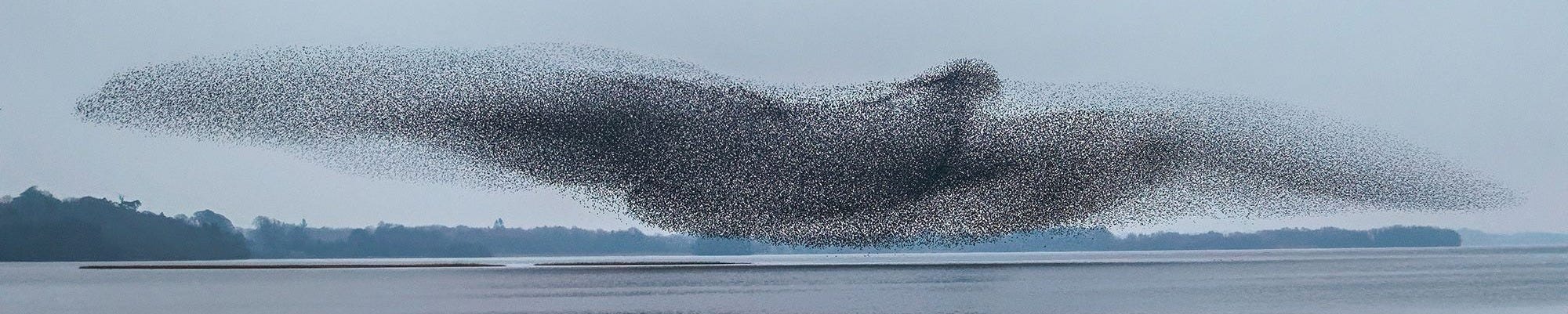
We are learning how to move from hierarchy toward something more distributed. We are learning how to coordinate like a murmuration of starlings or a school of fish rather than an army following orders.
And because we have not learned these skills yet, of course we will bump into each other. Of course there will be conflict. Of course it will be messy.
Because we are learning a new way of being human together.
Leadership will continue to emerge wherever it is needed. That is the nature of life. But perhaps leadership can become a role rather than an identity. A function rather than a throne. A responsibility rather than a status.
Leadership is possible without hoarding power.
And perhaps that is the deeper cultural shift we are being invited into - not simply replacing who sits at the top of the pyramid, but questioning why the pyramid exists at all.
I do not pretend to have a blueprint for what comes next.
I do not know exactly what a post-presidential society would look like, or how power might be distributed in ways that remain both functional and just.
But I do know that our current systems ask too much of too few people while asking too little of the rest of us.
The challenge before us may not be finding better leaders.
It may be becoming better participants.
Better stewards.
Better relatives to one another.
The future may depend less on who leads us and more on whether we are willing to share the responsibility of leadership itself.
Kazu, so much here. Thank you. Reminds me of a recording of a conversation between Nikki Giovanni and James Baldwin. Baldwin says, "God is our responsibility.....God's only hope is us......if we don't make it, he ain't going to mKe it either."
I really appreciate this reflection, Kazu.