

The other day, I went to my Sangha for our weekly sit, after which we share a meal. We spend the first five minutes eating in silence, practicing mindful eating. This is sometimes a challenge, since we always have our 21-month-old with us and we are busy feeding and caring for her.
And yet, it has become a really beautiful practice - one that my partner and I sometimes lovingly refer to as “mindful childcare.” It can be a challenging practice: feeding a toddler, trying to prevent her from throwing all her food onto the floor, deciphering her not-always-clear communication, eating my own food and allowing my heart to rest - all while trying to stay present with each moment. What a great teacher she is.
After our five minutes of mindful eating, we go around the circle for a short dharma share. An opportunity for each person to speak to whatever is alive in their hearts and minds. As I sat there, I found myself thinking about Kaira Jewel Lingo’s recent piece on writing a “Love Letter to an ICE Agent.”
In the face of so much violence by federal agents - including the murder of Renée Good and Alex Peretti, and the kidnapping of Liam Ramos - it is certainly a huge challenge to imagine loving an ICE agent. And yet, as I reflected on her piece, and on how my own daughter, tantrums and all, continues to be one of my greatest teachers, I also found myself returning to the teaching that our greatest enemies can also be our greatest teachers.
I was struck by both the beauty and the complexity of the idea that the person I love the most in this world (my daughter) and some of the people who currently challenge my capacity for love the most (ICE agents) might both be among my greatest teachers.
What Are You Saying?
Over the past couple of months, I have been amazed at how quickly my daughter learns, how much she understands, and how much she can communicate with words. She can say so much now, and knows words in four different languages!
And… there are still moments when she is clearly trying to tell me something and I can’t help but wonder, “what the f*** are you trying to tell me child???” She is still at a stage of development where communication is not always clear.
And in those moments, I try my not match her frustration with my own. I try to stay grounded and lean in with compassion and curiosity. Not, “what the f*** are you trying to say,” but “I truly want to understand what you are trying to communicate, and I will do my best to do so.”
Marshall Rosenberg, founder of Nonviolent Communication (NVC), taught that everything we say and do as human beings is an attempt to meet universal needs – needs for safety, for meaning, belonging, to be heard and be seen. Sometimes, we choose unfortunate strategies to meet those needs. Even when a strategy causes harm, it is still rooted in a very human attempt to meet a shared need. I see this in my daughter almost every day.
One of my favorite definitions of violence comes from Rosenberg, who said that “violence is the tragic expression of unmet needs.”
So, when my daughter acts out because I am unable to understand her needs, my work is to slow down and get curious.
And that is the challenge that Kaira Jewel is inviting us into: can I extend that same curiosity to the ICE officer?
There is no way for me to say this without it sounding condescending or patronizing, so I will just say it and try to clean it up later. Part of me believes that when any law enforcement officer engages in violence, they are choosing an incredibly tragic strategy to meet an unmet need. And, like my 21-month-old daughter, they may not be developed enough to be connected to their own feelings and needs, which is what leads to them choosing these tragic strategies.
This is not to deny their responsibility or agency, but to name a lack of spiritual development that our culture actively cultivates.
Of course they are fully developed in the physical sense. But spiritually, they are living in the delusional worldview of separation and individualism, believing that they can meet their needs and get closer to freedom by oppressing another human being.
I want to pause here and be clear that I am far from being liberated myself. While I may not act out in violence, the seed of a fractured worldview arises in me regularly, and I notice the impulse to blame or shame another person so I can feel better.
What I do have is the privilege of a spiritual community that supports me with this path, and the fortune of having teachers like Kaira Jewel, who reminds us that freedom comes from remembering that we belong to an infinitely vast web of interdependence.
When I first met Kaira Jewel, she was still a monastic in the Plum Village tradition. She happened to lead a small dharma sharing group at a retreat that I attended, and during one conversation she said something that always stayed with me: “we have to learn to have compassion for people’s ignorance.”
She did not use the word “ignorance” in the sense of stupidity, but in the sense that so many of us – myself included – often see through a limited lens and forget that our destinies are bound together. We forget that none of us will never be free until all life is. In that way, we are all at times ignorant of the truth of interdependence.
So, can I have the courage to extend the same curiosity that I have for my daughter to an ICE officer? Can I pause long enough to trust that they are not tearing apart our communities because they are purely evil without denying the very real harm they cause?? Can I have compassion for their ignorance? Can I allow myself to learn from the attempt to to see the world from their eyes?
What’s Beneath Their Cries
When my daughter cries or acts out, if I can slow down enough to truly listen, it becomes clear that she is trying to meet a basic need. She wants attention (need for connection or to be heard), is hungry (food and physical comfort) or is bored (fun, joy, stimulation).
This is the same NVC lens I described earlier: that everything we say and do is an attempt to meet a basic, universal human need, and that our strategies, whether harmful or not, emerge from those needs.
It may be hard to see that behind the violent actions of ICE officers, they are yearning desperately for a need to get met. It may be hard to imagine that even beatings, tear gas and fatal shootings are a tragic expression of those unmet needs.
It’s hard in part because their actions and the strategies they are choosing are obscured by so many layers of weapons, centuries old trauma from colonization and stolen land, the normalization of authoritarianism, the rise of white supremacy and nationalism, a culture of state sanctioned violence and so much more.
The body armor they wear is not only made of metal, but also carries centuries of collective trauma shaped by state violence, trauma that engulfs the humanity of those wearing it.
To me, a commitment to nonviolence in these times is a commitment to doing our own inner work enough that we can slow down to see this. To try to pierce through all the layers of physical and symbolic armor and glimpse the human needs desperately trying to be heard.
I’ve never met an ICE agent. But I have worked with many police officers and prison guards. I have built relationships with them over decades of working with incarcerated people, have facilitated trauma healing circles with many of them and witnessed the pain they carry behind their badges and uniforms.
I remember the cop who once told me about having to shoot and kill an armed suspect who was firing at him. Behind his lightly tinted sunglasses, I saw tears well up as he told me how hard it was for him to live with that.
I remember sitting in a circle of prison guards in street clothes when one casually said to his 20 colleagues “we all know someone who has committed suicide” as if that was a perfectly normal thing.
I remember having dinner with someone who just came home from 30 years of incarceration, telling him about some of what I heard in those circles with prison guards and him saying, “Man… it sounds like they were doing time.”
And I also remember meeting prison guards who cared more for the humanity of incarcerated people than many anti-prison activists that I have known. People that took risks and even broke laws to protect dignity, shift prison culture, and uplift the leadership and creativity of people inside.
Years ago, I worked with a man serving a life-sentence for a homicide he committed as a young man. When recounting his story, he told me that every time he pulled the trigger, it felt like he was “throwing his pain at his victim.”
The pain of a lifetime of poverty. The pain of generations of violence against Black. The pain of witnessing his mother’s abuse.
It was clear he desperately needed healing, release, to be heard, for his pain to be witnessed and validated. And tragically, largely because of the same systems that created those wounds in the first place, he was never given access to healthier strategies to get those needs met. He “chose” a tragic one: a gun.
Is it possible that there is a similar dynamic going on with ICE agents? That alongside their own fear about the future of this country or their own insecurities about their families’ financial futures, they are acting out centuries of violence held in the collective body of this nation-state?
Is it possible that the very real violence and injustice they participate in is also a cry for help, a tragic expression of unmet needs?
I am curious…
Loving Accountability
Let me be clear: I believe that ICE, police, prisons and our criminal justice system are not only ineffective at what they claim to do, but actively contributes to more fractured and violent world.
In this moment especially, ICE is ripping families apart, instilling terror in communities, harming innocent people, killing protesters and traumatizing children. They need to be stopped.
If my child chooses strategies to get her needs met that is causing harm (or creating more of a mess than I am able to deal with in that moment), my job as a parent is to gently stop her and hold her accountable.
How can I hold that same attitude towards the ICE officer? To remember that as a fellow human being whose liberation is bound with mine, part of my job is to stop them and hold them accountable?
Not as punishment, since I believe punishment does the exact opposite of true accountability. But as an opportunity for awakening, growth and wholeness.
When someone participates in a violent system, nobody escapes the harm. ICE is a violent system, and it is not healthy for the soul of an ICE agent to be part of it. We have to do everything we can to stop them from spreading that harm, but in a way that leaves open the possibility of their healing. In a way that acknowledges that part of our work is to help people escape violent systems, and ultimately violent worldviews.
As one civil rights elder once told me, “the Civil Rights Movement was a battle for the bodies of Black folks and the souls of white folks.”
How can we take the same approach, and resist to protect the bodies of migrant communities while also struggle to free the souls of those committed to fracture?
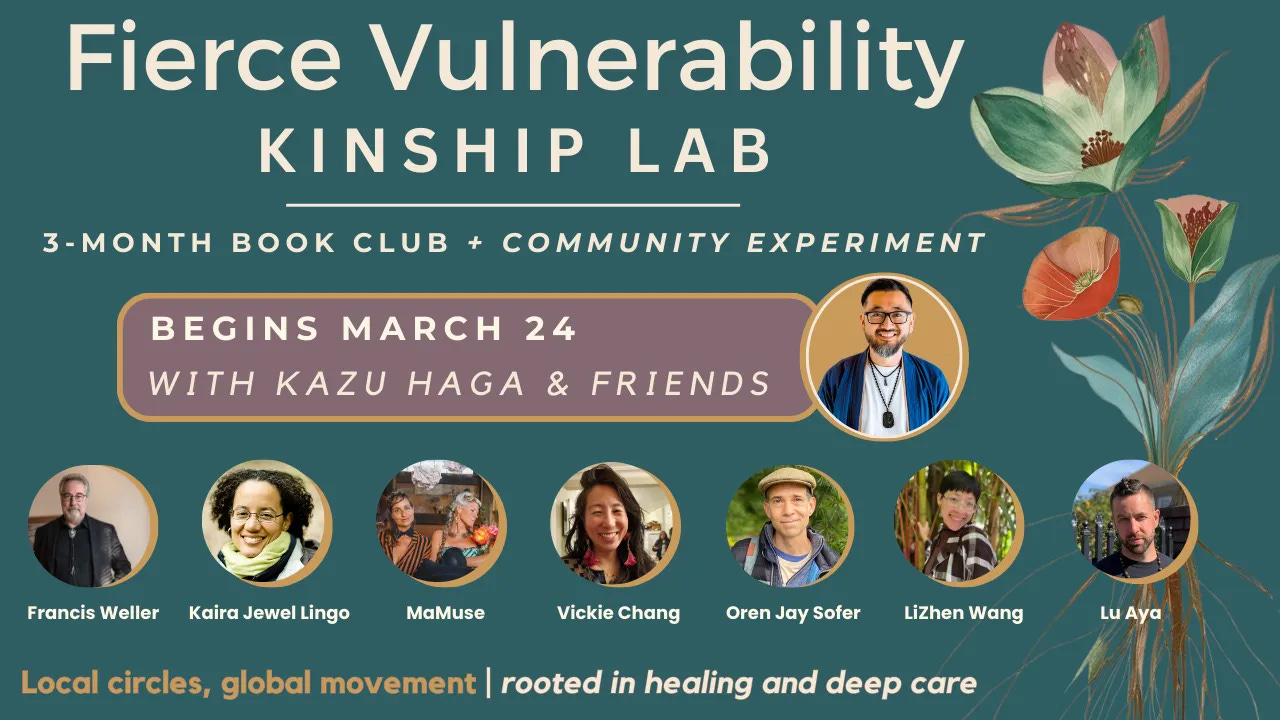
I am so excited that Kaira Jewel will join us as one of our guest speakers for the Fierce Vulnerability Kinship Lab, a three-month workshop and community building experiment starting at the end of March.
Find out more about this program and join us with some friends!
If you are not already, subscribe to Kaira Jewels substack for more wisdom at the intersection of spirituality and social change.

Make sure to sign up for my newsletter on my website to get monthly updates on upcoming workshops and events, podcasts and much more! Visit me at www.kazuhaga.com.
To support my work, please consider signing up as a paid member, or by making a recurring or one-time donation on my website.
Hi Kazu, this is a beautifully expressed piece. Just the other day I wrote this to a colleague who wrote the word “goons” to describe ICE agents, which in a small way echoes what you are saying:
“I am averse to calling ICE agents "goons." Watching the horrors they are inflicting on folks makes us angry, so it's tempting to turn them into the enemy by calling them names. However, they are human beings caught in an oppressive system, who, in my opinion, are acting out of their own hurts and fears. Each of them has Buddha nature or Christ nature or other terms we might use. Thich Nhah Hanh (among many others) taught human beings are not the enemy; hate, greed, and ignorance are the enemy. In our Beloved Community Circles, we try our best not to dehumanize anyone, even those who dehumanize us. We call them out for unjust or cruel behavior, try to stop or minimize their bad behavior, and hold them accountable, but we don't make them into the "other". Can we simply use the term "ICE agents"? I just read this article called "The Deeper Antidote to Fascism is Connection" that beautifully elaborates on the practice. May it be of use.” https://stephendinan.substack.com/p/the-deeper-antidote-to-fascism-is
In a similar effort, after the Jan 6th insurrection, I wrote a “love letter” similar to Kaira Jewel’s, to the insurrectionists. Here's the link, in case you are interested. https://docs.google.com/document/d/1qeZdoSs1IfVtMna9ZyYGoI-El_arq2Q4/edit?usp=sharing&ouid=100502709275654834146&rtpof=true&sd=true
in solidarity, John
Thank you so much for this, Kazu. I was struck by the words “throwing his pain at his victim.” I have felt for some time that those os us who aren’t able to be with or hold their pain put it on to others (in so many different ways). As you say he needed his ‘pain to be witnessed and validated.’
I believe that is so needed in these times.
I believe one way we can learn to be with pain, so we don’t put it on others, is by having it be wit(h)nessed.
May those of us causing harm have spaces for the pain to be wit(h)nessed and may there be a willingness for the pain to be wit(h)nessed and may we wit(h)ness the pain with compassion, forgiveness, and love.
I appreciate the comment above referencing Thich That Hanh.
I’ve been meditating on this poem by him recently:
https://plumvillage.org/articles/recommendation